"We can be our own broadcaster now": how Tony Comiti Productions is building a multiplatform business
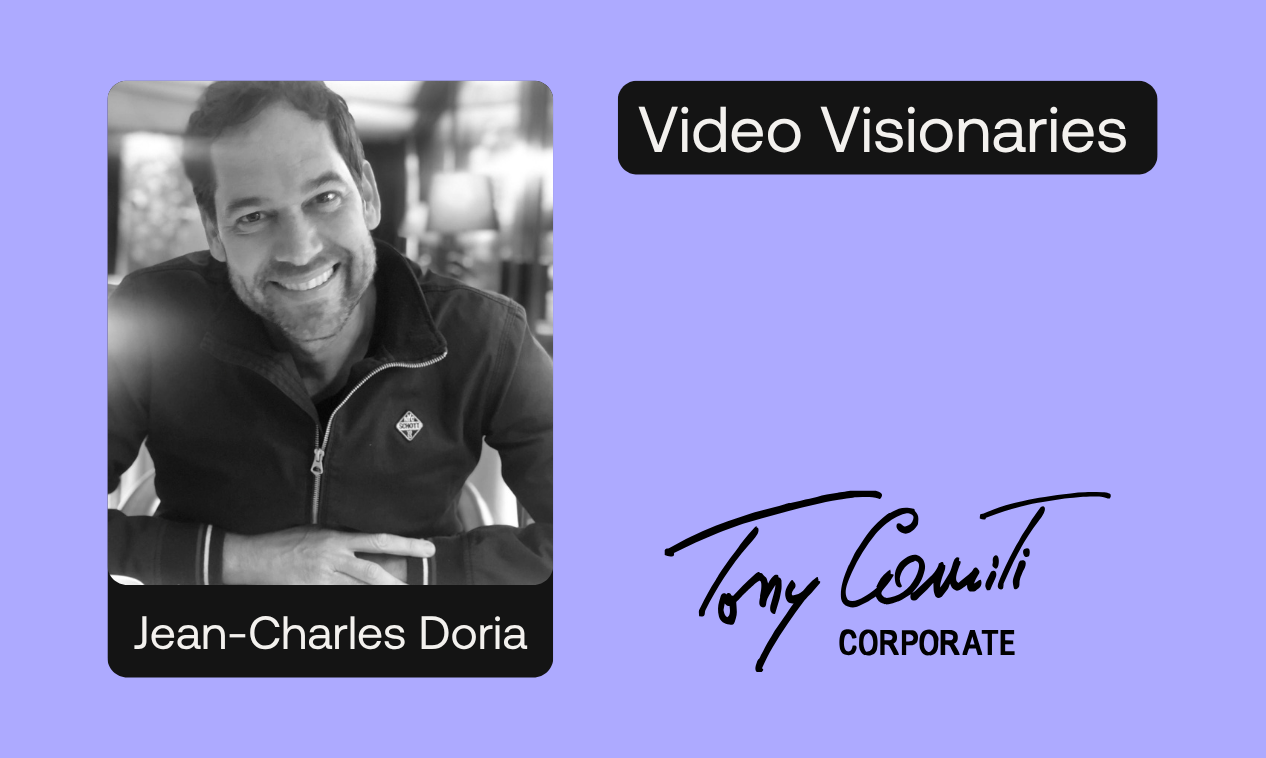
Tony Comiti Productions has spent more than a decade building a business beyond traditional television, turning its catalog into an asset used across the company and monetized around the world. Editorial producer Jean-Charles Doria explains how the production company is connecting its television roots with a multiplatform future.
By Lorene · Interviews · 7 min read
Jean-Charles Doria is editorial producer and Digital Lead at Tony Comiti Productions, a French production company founded in 1993 by Tony Comiti. At the agency, he wears two hats: managing a catalog of nearly 3,000 documentaries and reports, and producing a weekly show for social platforms called "Mon Incroyable Histoire" ("My Incredible Story"). Today, Tony Comiti Média has reached more than 120,000 YouTube subscribers, while "Mon Incroyable Histoire" has repeatedly ranked among France's top 3 podcasts in recent months.
What made you turn toward digital after 15 years directing TV reports at Tony Comiti?
I'd always kept one eye on new platforms, back to the early internet days when I was a journalist for a site called alafolie.com, and later as Facebook, YouTube, Instagram and TikTok arrived. I had a feeling TV would eventually have to work with these platforms, not against them. Then, four years ago, I had a scooter accident and was stuck at home for three months. That forced pause is what pushed me to write a business plan for my own role at the company: stop producing for TV, build a small team of journalists and editors dedicated to social platforms, and take on managing the catalog as well.
You've described your job as two roles in one. What are they?
About half of my time goes into making content and getting it onto the right platforms, mostly through our show "Mon Incroyable Histoire": I recruit the team, validate every format, every edit, every title, every thumbnail, and interview the guests. The other half is managing our catalog of nearly 3,000 titles and making sure it earns its keep, which I do with four partners. The two overlap constantly: the catalog gives the show its raw material, and every episode we publish becomes part of that same catalog.
Tell me about "Mon Incroyable Histoire."
It started as a 10-minute, vertical, face-camera format, and it took off on Facebook. We made real money from it, until Facebook's ad model collapsed and we lost 90% of that revenue, along with everyone else. So we rebuilt it as a 40-to-50-minute portrait interview, using our catalog to illustrate each person's story. We match the footage to exactly what they're describing, so it feels like we've been filming that person their whole life. We publish a new episode every Friday at 4:30 p.m., across YouTube, Spotify, and shorts on TikTok, Facebook and Instagram, and we're 15 weeks ahead on production.
What actually drives your digital revenue today?
YouTube first. It's the most stable platform, no big surprises in payouts, so we design every show for YouTube before anything else. YouTube keeps roughly half of what the advertiser pays, but the payouts are steady and predictable. Spotify is newer for us, about six months in, and it already pays more than double what YouTube does per view, with a smaller cut taken out. We're not there yet on volume, but I'm looking hard at building content made specifically for Spotify, because it could be a major partner for us.
The other half of your job is the catalog. What role does Moments Lab play in that?
Moments Lab is the memory of the company. We've put everything we've published there, not the raw rushes, and it's become far more than storage. It's an investigation and pre-investigation tool for the entire company: reporters and editors use it to prepare new stories, for example by finding every sequence in our catalog where a particular name was mentioned. For "Mon Incroyable Histoire," it's also how we find the exact shot to illustrate someone's story, down to something as specific as a shot of a mug. Without a tool like this, finding that kind of footage across nearly 3,000 programs would be almost impossible. That precision is what turns a flat interview into something people actually watch.
What convinced you to migrate your archive to Moments Lab?
Before Moments Lab, our archive was managed by our previous provider. We'd actually started digitizing early: back in 2010, Alain Debosse made the decision to master our entire tape archive. Our previous provider stored those masters and provided a fairly basic search engine that we'd relied on for years. We'd also been feeling AI emerge over the previous few years, and wanted to move toward something better. What convinced us was the team, real documentalists who understood the actual problem: finding one specific scene inside nearly 3,000 documentaries, not 10. The economics also made sense. Our previous setup required two people to manage the archive: a documentalist and Alain. Moving to Moments Lab meant that work no longer required two dedicated roles: Alain now works on other things, and we kept everything our documentalist had indexed before she moved on.
Beyond Moments Lab, you work with three other partners to make the catalog pay. How does that work?
One partner tracks piracy, recovers monetization, distributes our content across its social channels and translates it into 15 to 30 languages. They work within the rights available for each title and territory, and their channels reach millions of subscribers across YouTube, Facebook and TikTok, and at this point we couldn't do without that reach. They pull what they need almost like an open bar, straight from Moments Lab, based on the trust we've built together. Another partner runs our Facebook page, which we'd let go dormant, and now has 150,000 followers, plus our Spotify publishing for "Mon Incroyable Histoire." And a third handles international sales to broadcasters in places like Germany, Japan and Spain.
Where do you see the industry heading, and what's your philosophy on new technology?
TV ad revenue keeps falling and it's pushing everyone toward what the channels call "platformization": a show is no longer tied to one channel, it lives on YouTube, on the broadcaster's own service and sometimes on Amazon, all at once. We've been working with YouTube for a decade because we were convinced early on that television would eventually have to coexist with social platforms. My take is you have to bet early even when the payoff isn't guaranteed, because until now a production company got a budget from a channel and worked inside it. Going direct means the money comes out of our own pocket first, with the hope of earning it back. That takes patience and a thick skin, but it also means we keep the final cut. We're piloting voice-cloned dubbing to help stories travel further internationally, not just subtitles: we're currently internationalizing five episodes of "Mon Incroyable Histoire" using cloned voices. One early piece featuring Tony Comiti's encounter with Pablo Escobar has since been dubbed into a dozen languages using cloned voices and has racked up more than 12 million views.
What's exciting you right now?
Growing "Mon Incroyable Histoire." I interview three or four people a week, each with a story worth two hours of tape that we cut down to an episode. Getting someone to open up like that in two hours still feels like a small miracle to me, and it's the part of journalism I never wanted to give up. What's satisfying is watching the show mature: it started as a quick face-camera format with no editor, and it's now built to broadcast standards, narration, sound, lighting, even marketing. If a channel wanted it tomorrow, we could hand them a finished show.
What would you tell another production company sitting on a catalog and still on the fence about digital?
Go now. It's late, but you don't have a choice. Go with what's already in your catalog. Don't try to build a TV show for social, it costs too much. Find something simple you already know how to make. And go alone, or team up with other producers to share costs, but don't hand your rights to a big broadcaster for a small upfront check. Rights are everything. For the first time, we can act like our own broadcaster on social platforms and keep the final cut. Our YouTube channel is one year old and already at more than 120,000 subscribers. Selling a report to a channel only gives up the TV rights, not the digital ones, so there's real upside left on the table if you go after it yourself.
Book a demo to see how Moments Lab helps production companies turn the shows they already own into more social video.
.avif)