From Local Hits to Global Franchises: Former Prime Video Europe CEO Brigitte Ricou-Bellan on IP, Social and the Future of TV
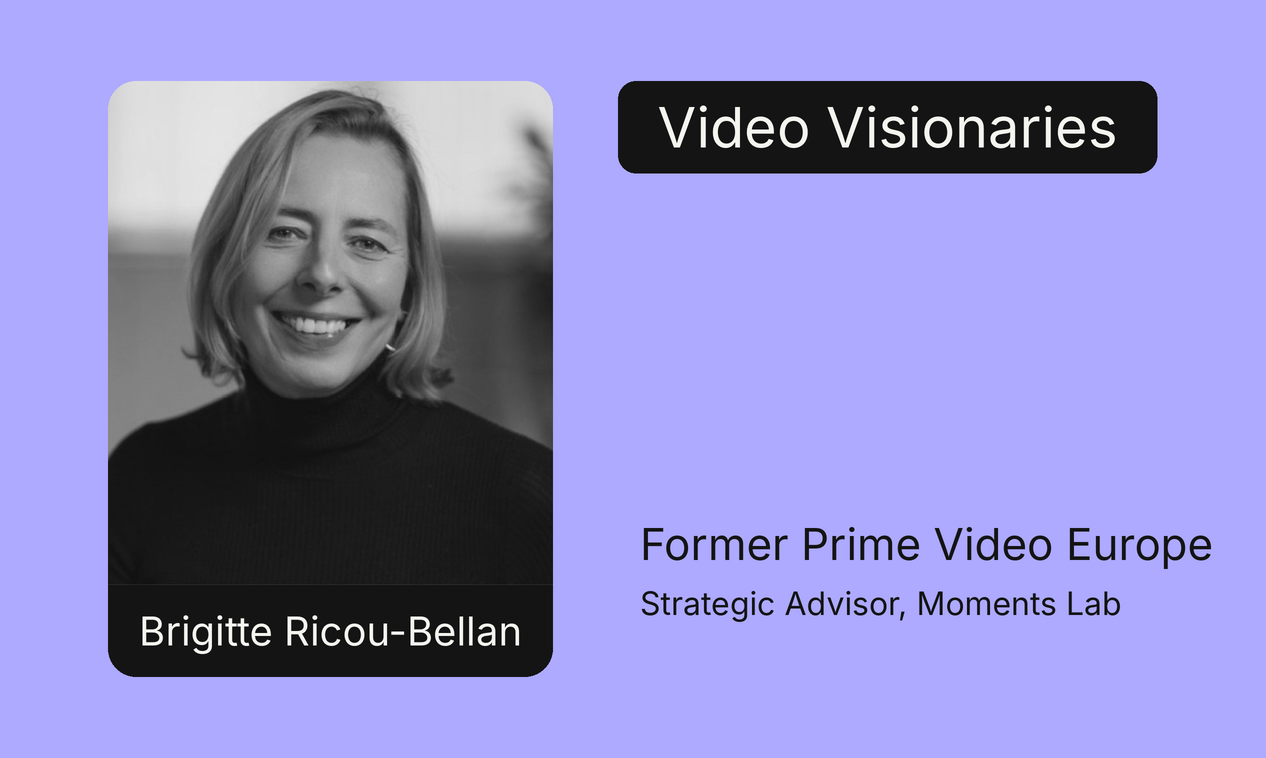
In this interview, Brigitte Ricou-Bellan, who led Prime Video across five major European markets, explains why strong IP still wins, how social media changed the way audiences find shows, and where AI fits in.
Brigitte Ricou-Bellan has held leadership roles at Dow Jones, eBay, StubHub and TES Global, in both Europe and the US. She then joined Amazon as managing director for books, media and entertainment, and consumer electronics, before moving to Prime Video to lead the business in Europe across the U.K., Germany, Italy, France and Spain. Today she sits on boards, advises companies (including Moments Lab), and is preparing to teach MBA courses on AI.
You've worked across a range of industries. How did you end up at Prime Video?
Most of my career has been about building and leading marketplaces, digital subscriptions and content services, in both the U.S. and Europe. A common thread for me is a real passion for entertainment and the arts: film, TV, books and theater. Believe it or not, my very first role was in theater, a long time ago. I've always cared about the stories, and about the technology that brings them to audiences.
At eBay, I launched an international ticketing business, working with rights holders in sports, music and some theater, first in the U.K. and then in Germany. Prime Video brought a lot of it together: content, technology and audiences. I led it across five major European markets. We drove monetization through advertising, had tremendous growth, and brought European stories to very broad audiences. I was on the business side, but I also set up a team focused on scaling AI to improve our content operations.
What's your biggest takeaway from your time at Prime Video?
The most consequential decisions our teams were making were all about content: what we license, where we invest, where we own the IP, which stories we commission, and how we build an offer for very different audiences, including younger ones. It's both art and science. We used data, but there's a lot of creative judgment, and these are very expensive decisions.
You worked across five very different markets. How do you balance local stories with global reach?
Content is extremely local in many ways. You need stories that resonate with local culture. But sometimes something made locally travels, and that's the most exciting thing ever. One of the things I loved about leading five European markets was seeing how far a story like Culpa Mía could travel without losing what made it local.
The Culpables trilogy — Culpa Mía, Culpa Tuya and Culpa Nuestra, based on Mercedes Ron's novels — is a wonderful example of Spanish storytelling connecting with international audiences.
It's a universal story, a love triangle, very well executed, with young actors who were known locally. Then social buzz and word of mouth took over, first across Spanish-speaking countries and then globally. The books, which already had an audience in Spain, became a much bigger hit too. It created a real flywheel.
What separates IP with lasting power from a show that fades after a season or two?
Gosh, if I knew that, I'd probably be doing something different! It comes back to storytelling, and whether a story is relevant at a certain moment, and resonates with certain audiences. What stays constant is the focus on IP, whether it comes from books, films or gaming, like "Fallout," a successful adaptation of gaming IP into a compelling television series.
When an IP has had some success, there are ways to re-energize it, and that's what excites me about AI and new formats. Look at "Neighbours," the long-running soap that started in Australia. There are now short films built around specific characters. That's a smart way to extend the life of an IP.
How has the way people discover shows changed over the last 10 years?
The big shift has been social, no question. When the streamers launched, they did a lot of above-the-line marketing, including TV ads. Now the focus is on different formats that engage audiences before, during and after a release. Marketing teams need to clip content quickly, sometimes while the show is still filming, to build anticipation. With franchises, short-form and behind-the-scenes content keeps the excitement going between seasons.
Some of those clips come from fans. Should rights owners see them as a threat or a free marketing team?
This is my own opinion, but I take a positive view. Sometimes it's engineered through influencers and creators, which all the streamers already do in a big way. But some of the best things I've seen were completely organic. Ahead of a new season of "Maxton Hall," from Germany, a young fan of one of the actors recorded a little video about the show coming soon. It was so much fun we shared it in executive meetings. That's free marketing. And I see much more focus now on building a portfolio of clips around a show to promote it and extend its life. AI tools make more of that possible.
What's the biggest change in the industry beyond social?
The convergence of broadcasters and streamers. Most broadcasters, like Arte, TF1 and the BBC to quote a few, now have their own streaming services. And streamers are becoming the destination for content that isn't their own, for example France TV on Prime Video in France, or TF1 on Netflix. Audiences want flexibility and one place to go. Watching at a set time is behind us, except for live events, and we also see streamers moving into live sports and entertainment.
And often the journey starts on social. My two kids, who are in their 20s, discover and watch a lot on TikTok and YouTube. For traditional broadcasters, digital distribution and promotion are existentially important. YouTube is a competitor, yes, but it's also a channel that can amplify.
Which new formats are catching your attention?
I love long form, and I love movies, including going to theaters to watch films. But short form can be really interesting. Everyone talks about vertical dramas, and I'm also interested in video podcasts and in recomposing documentary content from archive footage. One format I find engaging is "Fragments" from Arte: one person telling one intimate story from their life for four or five minutes. It's a bit niche, but very innovative in my mind.
Where does AI fit in, and why did you decide to work with Moments Lab?
I see AI as an accelerator, especially agentic AI, for discovery in catalogs and archives and for creating new formats. At the same time, I strongly believe content creation and IP are human. AI is there to help and accelerate.
I met Moments Lab founders through one of the company's investors. What I liked is the idea of helping rights owners, production companies, broadcasters and streamers do more with their content: make it searchable, create promotional material more easily, and find new ideas to extend its life. There's so much value that can be created there, and I'm very excited to be part of the journey.
Book a demo to see how Moments Lab helps rights owners find the best moments in their catalogs and turn them into more social video.