Mastering Agentic AI for Better Video Search
Article overview:
- Agentic AI transforms video search from keyword matching to intelligent, autonomous discovery that understands content context and user intent—Gartner projects 33 percent of enterprise software will incorporate agentic AI by 2028
- Agents use multimodal AI to analyze visual content, speech, on-screen text and semantic context to create comprehensive searchable indexes
- Agentic AI empowers users to talk to their media library through conversational prompts, just as they would talk to a colleague, resulting in dramatic time savings and productivity gains through reduced time spent searching for exact clips
- Best practices include starting with clear use cases, establishing human-AI workflows, training users effectively, and maintaining governance
Finding a single moment in thousands of hours of video footage once meant hours, sometimes even days, of manual scrubbing. Today, agentic AI for video search transforms that process into a conversation—simply ask for what you need, and intelligent systems are set to research: analyzing, locating, and delivering the exact clip in a flash.
This shift represents more than incremental improvement. As video content continues to grow across every industry—from newsrooms racing to publish breaking stories to production houses repurposing decades of show archives—traditional search methods have reached their limits. According to Forrester, 62 percent of enterprises struggle with organizing and retrieving video content efficiently. Agentic AI offers a fundamentally different approach: autonomous research systems that don't just respond to queries but can also actively reason through complex requests, cross-reference multiple data sources, and deliver precisely what users need.
In this guide we’ll explore how agentic AI for video search works, its practical benefits across industries, some of the challenges you may face during implementation, and look at some best practices for organizations getting ready to unlock the value trapped in their video libraries.
What is agentic AI, and how is it used in video search?
Agentic AI systems can plan, act and adapt independently across complex workflows. They're not passive tools, nor are they stuck in one-step silos; they're proactive research agents capable of breaking down multi-step problems, executing tasks autonomously, and refining their approach based on results without needing further prompting.
Gartner projects that by 2028, 33 percent of enterprise software applications will incorporate agentic AI—a dramatic rise from less than 1 percent in 2024—with as much as 15 percent of daily business decisions to be autonomously handled by these systems.
In the world of video search and content discovery, agentic AI can transform how organizations interact with their media libraries. Rather than relying on basic metadata searches—where the system looks for keywords in file names or manually tagged descriptions—agentic AI systems are able to understand the actual content within videos. They can analyze visual elements, spoken dialogue, on-screen text, emotional tone and contextual relationships to surface exactly what users need.
The limitations of traditional video search
Traditional video search relies heavily on metadata, which is information about the video, rather than an understanding of what's in the video. This might include:
- File names and folder structures
- Manual tags added by archivists
- Basic timestamps
- Actor or participant names
This approach risks creating significant gaps. A news organization might have footage of a specific event, but unless someone manually tagged that footage with the right keywords, it remains buried. Production companies may be sitting on decades’ worth of potentially valuable content that's effectively invisible because no one has cataloged every single moment.
How agentic AI changes the equation
Agentic AI for video search addresses these limitations through several key capabilities:
- Multimodal understanding: These systems analyze video through multiple channels simultaneously, including visual content, audio transcription, on-screen text, speaker identification and scene context. This creates a rich, searchable index that captures what's actually happening in each moment of footage.
- Natural language interaction: Users search by describing what they need in plain language rather than constructing complex queries. Instead of searching for the exact term "interview_2024_CEO_Q3" to get content, a user might ask, "Find clips where our CEO discusses sustainability initiatives."
- Autonomous reasoning: Agentic systems don't just match keywords—they reason through requests. If a producer needs "emotional moments from last season's finale," the AI understands what constitutes emotional content and locates relevant scenes without requiring explicit tags.
- Iterative refinement: Unlike single-pass search tools, agentic AI can refine its approach based on results. If initial results don't match user intent, the system is able to adjust its strategy and try alternative approaches.
How does agentic AI-powered video search work?
Understanding the technical architecture behind agentic AI for video search helps organizations to evaluate solutions and set realistic expectations. While implementations vary, most systems share common components and workflows such as the following.
Multimodal indexing
The foundation of agentic video search is comprehensive indexing that captures multiple dimensions of video content:
- Visual analysis: Computer vision models identify objects, faces, locations, actions and scene compositions. Advanced systems recognize specific individuals, brand logos, landmarks and even emotional expressions.
- Speech-to-text transcription: Audio content is transcribed with speaker identification, enabling searches based on what people say in videos. Modern systems support dozens of languages and can handle multiple speakers with overlapping dialogue.
- Optical character recognition (OCR): On-screen text—lower thirds, graphics, signage, documents shown on camera—is extracted and indexed, making this information searchable too.
- Semantic understanding: Beyond identifying individual elements, agentic AI builds contextual understanding. It recognizes that a scene showing someone at a podium with cameras and microphones is likely a press conference, even without explicit labels.
Integration with existing workflows
Effective agentic AI for video search integrates with existing media workflows rather than requiring complete infrastructure overhauls:
- Cloud-based processing enables analysis of content wherever it's stored
- API connectivity allows integration with existing media asset management systems
- Role-based access ensures appropriate content security and rights management
- Export functionality delivers results in formats compatible with editing and distribution tools
What are the benefits of using agentic AI in video search?
The practical benefits of implementing agentic AI in your content discovery workflows extend across operational efficiency, asset value, competitive positioning and more. The research and reasoning power of an AI agent ecosystem can be truly powerful in broadcasting and production.
Time savings
The most immediate impact is speed. Tasks that previously required hours of manual review can be completed in minutes with the help of agentic AI tools that can talk to each other and pass along tasks without requiring additional human prompting. For organizations processing high volumes of video content—whether daily news operations or ongoing production—this can translate to significant productivity gains. Teams that once spent days locating specific footage can redirect that time toward creative work and more strategic initiatives.
Unlocking archive value
Media organizations sit on vast archives of historical content, often representing decades of investment. Traditional approaches leave much of this value inaccessible simply because content isn't cataloged at sufficient granularity. Agentic AI can scan through hours of archived footage and generate detailed metadata across sound and vision that wasn't available when that content was first produced. This level of granularity makes archived content far more discoverable, in turn opening new opportunities for monetization through licensing, distribution or direct-to-consumer platforms.
Enhanced content discovery
Beyond finding known content, agentic AI empowers users to discover content they didn't know existed. A producer researching a historical topic might discover relevant footage from unexpected sources—B-roll from unrelated shoots, archival interviews, or background footage that captures relevant moments. This serendipitous discovery can help to transform content creation by surfacing material that would never have been found through traditional keyword-matching searches, all thanks to the research power of the agents.
Improved operational efficiency
By turning time-consuming content search into a research conversation, agentic AI can help to reduce operational costs while improving output quality:
- Faster turnaround: Breaking news can be supplemented with any existing relevant archival footage within minutes
- Reduced duplication: Teams can verify whether footage already exists before commissioning new shoots
- Consistent output: Agentic AI-powered analysis can apply consistent discovery practices across entire libraries
- Democratized video search: Organizations can empower all staff to find what they need through conversational prompts, no specific MAM system search or taxonomy know-how required
Use cases for agentic AI in content discovery
Traditional AI search finds keywords. Agentic AI thinks like a researcher—it uses multimodal AI agents to interpret your goal, reason through your archive and deliver the exact moments you need. Here's how that difference plays out across industries through real world deployment.
Press and news organizations
When breaking news hits, journalists can't afford to scrub through hours of footage. They need context—historical clips, past interviews with key figures, related events—surfaced in minutes.
- Before: Keyword searches return hundreds of clips; editors manually reviewed each one.
- Now: You ask, "Show me every clip of [official] discussing [policy] in the last two years." The agent reasons across transcripts, visual cues and metadata to return ranked, time-coded moments.
Agentic AI can also synthesize information across sources, summarizing documents, flagging leads and extracting key details from archives that might develop into stories. It acts like a research partner, not just a search bar.
What this means for you: Your newsroom surfaces the right 15-second quote while competitors are still manually scanning messy folders.
Caveat: Accuracy depends on transcript quality and archive tagging. A short calibration phase—refining your controlled vocabulary—helps the AI agent to learn your in-house terminology.
Broadcasters
Younger audiences tend to access sports and news through clips on social media, not live broadcasts. This means broadcasters need to produce highlights at scale—across more events, faster, for more platforms.
- Before: Manual shot logging, time-consuming review, bottlenecked distribution.
- Now: You describe what you want ("best saves from tonight's match") and the agent identifies, clips and queues moments for distribution—without human review of every frame.
Agentic AI handles the reasoning. It’s able to understand what "best saves" means by combining visual analysis (player positions, ball trajectory) with contextual metadata (crowd noise spike, commentator emphasis). You just need to approve and publish.
What this means for you: Cover more events with the same team. Get highlights to social platforms in minutes, not hours.
Caveat: Complex highlight criteria (e.g. "controversial calls") may need more human oversight to ensure reliability.
Production companies
Production teams manage growing libraries—raw footage, completed shows, licensed content. Finding the right archived shot can mean the difference between a creative breakthrough and costly reshoots.
Before: You remember a shot exists but can't find it. Search returns file names, not scenes. Now: You ask, "Aerial drone shot of a coastal city at sunset, 4K or higher." The agent searches visually and semantically, returning clips ranked by relevance with timecodes.
Agentic AI goes further: through its ecosystem of research agents, it can cross-reference licensing status, resolution and usage rights, working to filter results to what you can actually use.
What this means for you: Find the moment you're picturing, not a list of files to review.
Caveat: Visual search accuracy improves with indexed archive depth. Newly ingested content needs processing time before it's fully searchable.
Sports organizations
Sports generates massive video volume—live broadcasts, training footage, decades of archives. Coaches need specific plays on demand. Fans expect instant highlights.
- Before: Analysts manually tag plays; coaches wait for overnight reports.
- Now: A coach asks, "Show me every time [player] ran this formation against zone defense." The agent searches across seasons, returning time-coded clips grouped by outcome.
For example, WRC Promoter (World Rally Championship) uses AI-powered media management to drive fan engagement across stages and countries. Intelligent search helps them create and distribute highlights rapidly—keeping pace with a sport that never stops moving, and action that is streamed live. Every day, they’re searching for images, creating social media graphics and short-form video, and carving out longer moments for listicle edits or feature pieces.
What this means for you: Coaches get tactical clips in minutes. Fans get highlights before they finish refreshing social media.
Caveat: Performance analysis queries work best when training footage is consistently ingested. Gaps in coverage can create blind spots.
Corporate marketing teams
Enterprise teams rely on video for training, product demos, executive communications and brand storytelling. But years of accumulated content often sits unsearchable.
- Before: Institutional knowledge trapped in unlabeled recordings. Finding a past CEO quote means watching hours of footage.
- Now: You ask, "Find every mention of [product launch] in executive town halls from 2022." The agent returns time-coded clips with transcripts.
What this means for you: Your video archive becomes a searchable knowledge base. Onboarding, compliance and decision-making get faster.
Caveat: Enterprise deployments require attention to access controls and data privacy. Look for platforms with SSO integration and portable metadata, with no vendor lock-in.
Why agentic AI, not just AI search?
Standard AI search matches terms. Agentic AI pursues goals. It:
- Reasons through ambiguous queries ("intense moments" → high motion + audio peaks)
- Chains tasks (find → clip → format → queue for export)
- Learns context (your terminology, your archive structure, your workflows)
The payoff: you describe what you need in plain language. The agent figures out how to get it.
What this means for you: Less time building complex filters. More time on creative and editorial decisions that matter.
What are the challenges of using agentic AI for video search?
Agentic AI can offer real advantages—but it also introduces new risks. Because these systems reason autonomously and chain tasks together, errors can compound and scale faster than with traditional tools. Understanding these challenges will help you plan better implementations.
Accuracy and hallucination
Any AI system can produce confident but incorrect outputs—a problem known as hallucination. With agentic AI, this risk grows: an agent that misidentifies a speaker or misattributes a quote doesn't just return a wrong result. As it reasons and sends tasks down the chain, it may end up clipping, formatting and queueing that error for distribution before anyone can review it. And for newsrooms and legal teams, a single misattributed clip can create serious problems.
How to mitigate:
- Build human review into workflows—especially before publishing or distribution
- Prioritize platforms trained on high-quality, domain-relevant data
What this means for you: Trust the agent, but keep a human in the loop for final approval on high-stakes content.
Security vulnerabilities
Agentic AI systems necessarily connect to external resources and execute actions autonomously. That autonomy can create new attack surfaces. Prompt injection, where malicious inputs manipulate AI behavior, has emerged as a real concern. Documented cases show attackers manipulating agents to access unauthorized resources or exfiltrate data.
How to mitigate:
- Implement strict access controls and authentication for agent actions
- Monitor agent behavior and establish anomaly detection
- Use air-gapped processing for sensitive or proprietary content
- Conduct regular security audits of AI integrations
- Choose vendors with demonstrated security practices and clear data policies
What this means for you: Your media is more able to remain private. Metadata remains portable.
Bias in training data
Agentic AI will reflect any biases present in its training data. For video search, this might show up as better recognition of certain demographics, languages or content types—potentially disadvantageous clips that don't match training patterns. An agent that systematically under-surfaces certain speakers or scenes isn't just inaccurate; it shapes what your team finds and uses, which in turn can impact culture and reputation.
How to mitigate:
- Test AI systems across diverse content types before committing
- Ask vendors for transparency about training data composition
- Monitor search results for systematic gaps
- Provide feedback to improve model performance over time
What this means for you: Run a pilot with representative content. Catch gaps early, before they shape months of output.
Integration complexity
Deploying agentic AI for video search means integrating with existing media workflows, storage systems and distribution platforms. Organizations with complex legacy infrastructure can often face significant hurdles.
- Before: Patchwork systems, manual handoffs, brittle connections.
- Now: Modern platforms offer robust APIs that plug into your existing stack—but the work of connecting them still takes planning.
How to mitigate:
- Prioritize solutions with strong API documentation and support
- Start with high-value use cases, then expand
- Confirm vendor support for your existing file formats and systems
- Budget for integration and customization work upfront
What this means for you: Plan a phased rollout. Prove value on one workflow before scaling across the organization.
Cost considerations
AI processing at scale requires significant compute resources. Agentic systems that reason, chain tasks and iterate then add to that load. Organizations must balance capability against cost—especially for large archives or high-volume processing.
How to mitigate:
- Understand pricing models thoroughly before committing
- Index high-value content first; expand as ROI proves out
- Consider hybrid approaches that combine agentic AI with traditional search for lower-priority archives
- Monitor usage and adjust processing strategies over time
What this means for you: Start with a defined proof of concept scope. Measure time saved and clips surfaced against compute spend to build your business case.
The bottom line
Agentic AI isn't magic—it's a tool that reasons, acts and learns. That autonomy has the potential to create value and risk in equal measure. The organizations more likely to succeed will be those that plan for both: capturing the speed and scale benefits while building in the guardrails that keep content accurate, secure and fair.
Tips for using agentic AI for content discovery
Organizations getting the most from agentic AI like the Moments Lab Discovery Agent follow consistent patterns.
Learn to prompt like you're talking to a researcher
Agentic AI responds to natural language—you don't need specific keywords or complex filters. But how you ask still shapes what you get back.
- Before: "interview CEO 2023 product launch" (keyword fragments)
- Now: "Find clips where our CEO discusses the 2023 product launch—especially moments where she explains why we pivoted."
Effective prompts share common traits:
- Describe what you're looking for, not how to find it
- Add context: time ranges, speakers, topics, emotional tone
- Be specific about the moment you need ("the part where...")
- Refine iteratively—ask follow-up questions like you would with a colleague
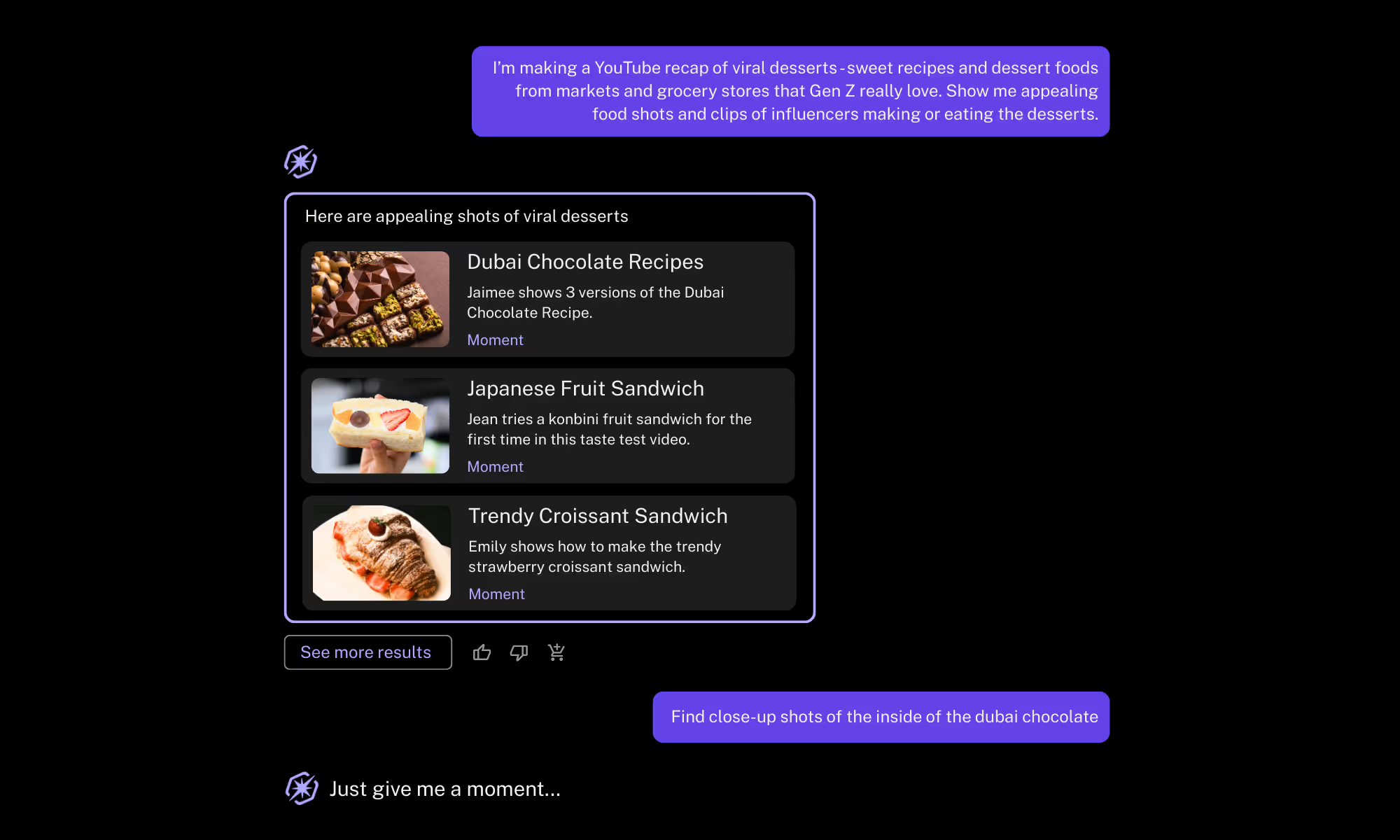
What this means for you: Skip the filter menus. Describe the clip you're picturing—the agent handles the rest.
Caveat: Prompting is a skill. Expect a short learning curve as your team discovers what works. Most users find their rhythm within a few sessions.
Start with high-value use cases
Don't deploy agentic AI everywhere at once. Identify specific workflows where faster discovery delivers measurable impact:
- Locating breaking news footage in minutes, not hours
- Enabling self-service access to marketing clip libraries
- Accelerating highlight production for sports or events
- Making training archives searchable for employees
Clear use cases help you measure ROI and build internal momentum for broader adoption.
What this means for you: Pick one workflow, prove value, then expand. Trying to transform everything at once can stall progress.
Design human-agent workflows
The most effective implementations pair agent speed with human judgment. Don't replace your team—augment them. Build workflows that:
- Use the agent for discovery—surfacing candidates from large archives
- Apply human review for final selection and verification
- Enable feedback loops so agent results improve over time
- Keep humans in control of publication and distribution decisions
What this means for you: The agent finds candidates in seconds. Your editors make the call on what ships.
Caveat: Fully automated pipelines can work for low-stakes content. For anything public-facing or sensitive, build in human checkpoints.
Prepare your content
Agent performance depends on what you feed it. Before deployment:
- Consolidate content from scattered storage systems
- Ensure clips are properly formatted and accessible
- Clean up metadata inconsistencies (speaker names, dates, project tags)
- Document rights and permissions so the AI agent can filter appropriately
What this means for you: A well-prepared archive returns better results from day one. Garbage in, garbage out still applies.
Measure what matters
Track metrics that reflect real business impact:
- Search success rate: Did users find the clip they needed?
- Time savings: How long did it take compared to before?
- Archive utilization: Is older content being rediscovered?
- User adoption: Are teams actually using the agent?
What this means for you: Baseline your current workflow before deployment; you can't prove ROI without a comparison point.
Establish governance for autonomous systems
Agentic AI acts on your behalf, but that autonomy requires clear accountability and governance processes. Consider:
- Document usage policies—who can use the agent, for what purposes
- Assigning accountability for agent-assisted decisions
- Maintaining audit trails for compliance and review
- Reviewing policies as agent capabilities evolve
What this means for you: Treat agent outputs like any other editorial decision—someone must own the final call.
Caveat: Governance isn't bureaucracy; it's protection. Clear policies help to prevent problems before they get a chance to escalate.
Future trends: How agentic AI could transform media asset management
The capabilities of agentic AI for video search are likely to continue advancing rapidly. Organizations should prepare for potential emerging trends, such as the below.
Multimodal search becomes standard
AI search will soon be inherently multimodal—users will search using text, voice, images or combinations of these. More importantly, AI systems will be able to respond with multimodal outputs: not just clips, but timelines, summaries, comparisons, and even auto-generated compilations.
Proactive intelligence
Current agentic AI responds to queries. Future systems could proactively surface relevant content based on context—alerting news teams when archived footage becomes relevant to breaking stories, or suggesting content opportunities based on trending topics.
Deeper integration with creation tools
The boundary between search and creation could continue to blur. Finding relevant footage and assembling it into rough cuts will become a single workflow, with AI handling technical tasks while humans guide creative direction.
Personalized and contextual results
AI systems are likely to increasingly understand user context—their role, current project, past preferences—to deliver more relevant results without explicitly stating things in queries. A sports producer working on a championship retrospective could see different results than a marketing team member seeking brand footage for the same organization.
Multi-agent collaboration
Rather than single AI systems, future workflows may involve multiple specialized agents collaborating. One expert in visual analysis, another in audio, a third in rights management, coordinated by orchestrating agents that manage complex multi-step projects.
Key takeaways: Agentic AI for video search
- Agentic AI transforms video search from keyword matching to intelligent, autonomous discovery that understands content context and user intent
- The technology has reached mainstream adoption, with Gartner projecting 33 percent of enterprise software will incorporate agentic AI by 2028
- Multimodal indexing analyzes visual content, speech, on-screen text and semantic context to create comprehensive searchable indexes
- Time savings can be dramatic—tasks requiring hours of manual review could now complete in minutes, with organizations reporting significant productivity gains
- Industry applications span press (faster breaking news), broadcasting (scalable highlight production), production (archive monetization), sports (fan engagement), and corporate (knowledge management)
- Real risks exist including hallucination, security vulnerabilities and bias—but these can be mitigated through human oversight, security protocols and diligent evaluation of potential vendors
- Best practices include starting with clear use cases, establishing human-AI workflows, training users effectively, and maintaining governance
- Future trends point toward proactive intelligence, deeper creation tool integration, and multi-agent collaboration
The teams that succeed with agentic AI don't try to transform everything overnight. They pick a painful workflow, prove value quickly, and expand from there. Ready to see if Moments Lab’s AI-powered video discovery platform is the right fit for you? Contact us for a demo.
Frequently asked questions about agentic AI for video search
What is agentic AI for video search?
Agentic AI for video search refers to autonomous artificial intelligence systems that can independently plan, execute and refine video content searches. Unlike traditional search tools that simply match keywords, agentic AI can understand video content through multiple modalities (visual, audio, text), reason through complex queries, and iteratively improve results to find exactly what users need.
How is agentic AI different from regular AI video search?
Traditional AI video search typically performs single-pass analysis—you enter a query, it returns results. Agentic AI can break down complex requests into sub-tasks, execute multi-step search strategies, evaluate its own results, and refine its approach when needed. This helps the system to handle nuanced queries like "find emotional moments" or "locate all competitor mentions in analyst interviews" that would be much more difficult with conventional search.
What types of organizations benefit most from agentic AI for video search?
Organizations with large video libraries and time-sensitive content needs could see the greatest benefits. This includes news organizations needing rapid access to archival footage, broadcasters producing highlights at scale, sports organizations managing event coverage, production companies monetizing content archives, and enterprises using video for training and communications.
What are the main risks of using agentic AI for video search?
Key risks include hallucination (AI generating confident but incorrect results), security vulnerabilities from autonomous systems with external access, bias reflecting training data limitations, and integration complexity with existing workflows. These risks can be mitigated through human oversight, security protocols, diverse training data, and phased implementation approaches, among other approaches.
How long does it take to implement agentic AI for video search?
Implementation timelines depend on content volume, existing infrastructure and integration requirements. Cloud-based solutions can begin processing content more quickly, while enterprise implementations with extensive customization will likely take much longer. Many organizations start with pilot projects on high-value content before moving to a more broad rollout.
Can agentic AI for video search work with existing media asset management systems?
Most modern agentic AI solutions offer API integrations with common media asset management systems. However, integration complexity varies based on existing infrastructure. Organizations should evaluate vendor integration capabilities and plan for potential customization needs during implementation planning.
What should organizations look for when evaluating agentic AI video search solutions?
Key evaluation criteria include:
- Multimodal analysis capabilities (visual, audio, text)
- Language support for your content
- Accuracy on your specific content types
- Integration capabilities with existing systems
- Security certifications and practices
- Pricing transparency
- Vendor track record with similar organizations
.avif)